
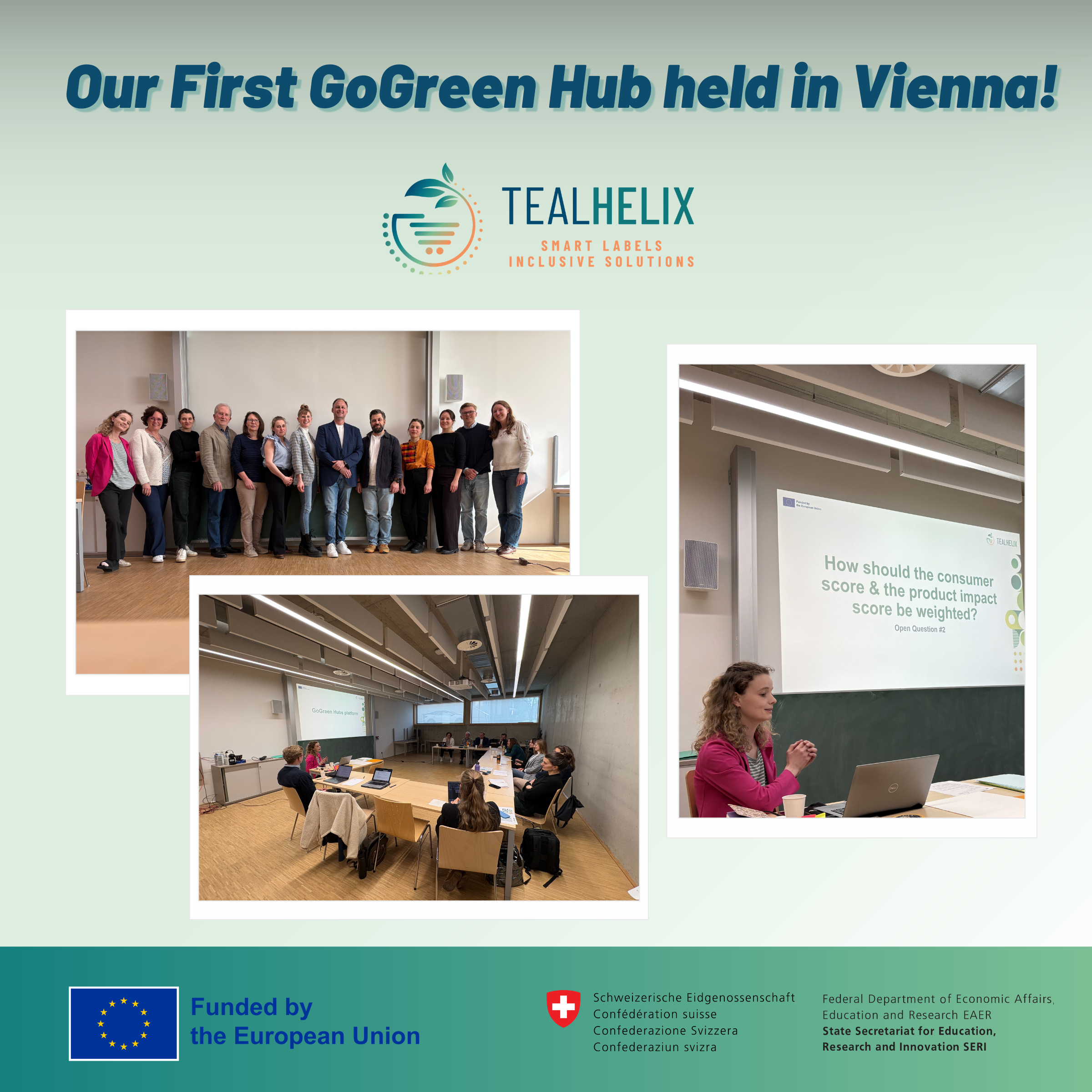
On 10 March, the TealHelix project held its first Go Green Hub at BOKU University in Vienna, hosted by BOKU in collaboration with GS1 Germany. The event brought together representatives from policymakers, government agencies, and NGOs active in the food sector, including organisations working on sustainability, food standards, and consumer information. Among others, representatives from the Austrian Agency for Health and Food Safety GmbH, Fairtrade Austria, GS1 Austria, and WWF Austria participated in the event.
The Go Green Hubs are a central component of the TealHelix project’s co-creation approach. These hubs are designed as collaborative spaces that bring together citizens, stakeholders, and experts to exchange ideas, share knowledge, and discuss sustainability-related challenges in food systems. Through these interactions, the project aims to better understand the needs and expectations of different stakeholder groups and explore how sustainability information can be communicated effectively and transparently.
In this context, this first session provided an opportunity to present the current status of the TealHelix project and gather feedback from external experts. Discussions focused on whether the project’s approaches to sustainability information and food labelling align with the real-world challenges faced by civil society organisations and public authorities. This exchange served as an important “reality check” for the consortium and helped identify key issues and perspectives that will inform the next stages of the project.
During the meeting, GS1 Germany presented an overview of current food labelling standards, as well as ongoing and future developments in digital product information, including the migration towards 2D QR codes, which are expected to play a growing role in providing consumers with more detailed product information.
By engaging stakeholders directly in the development process, Go Green Hubs help ensure that the project’s behavioural interventions, labelling approaches, and digital tools are informed by real-world perspectives. Insights gathered through these activities will contribute to refining TealHelix innovations and supporting the development of solutions that promote more sustainable and trustworthy food information for consumers.